JOJI Experiment 03 · Guidebook Available
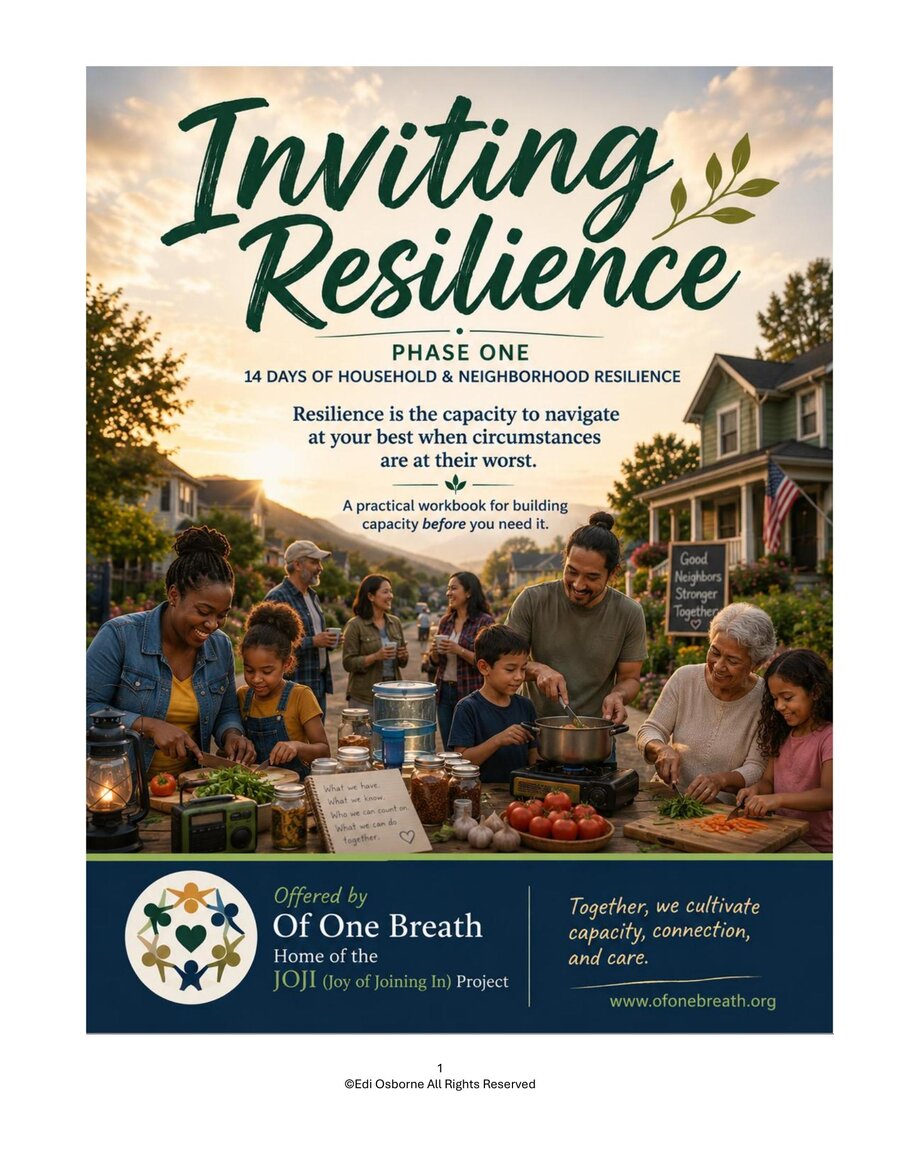
Inviting
Inviting
Resilience
Phase One: fourteen days of household & neighborhood resilience. A free, practical guidebook for building capacity before you need it.
Inviting, from the Latin invitare — to invite, summon, or entertain. An invitation is an opening, not a command. Resilience, from the Latin resilire — to spring back, to rebound. Together, they name a deliberate departure from emergency preparedness framed around fear, scarcity, and worst-case scenarios.
Written by Of One Breath founder Edi Osborne after her own family's wildfire evacuation, Inviting Resilience is a practical guidebook — not a survivalist manual. It helps a household build fourteen days of real stability, then widens the circle to neighbors: conversation starters, a sample neighborhood invitation, and a Good Neighbor Directory for discovering what skills, resources, and needs the people nearby already hold.
Resilience is the capacity to navigate at our best when circumstances are at their worst.We begin not with fear of what might happen, but with curiosity about what we can become capable of.
The guide calls this Resilient Communalism — not a surrender of self-reliance, but a build upon it:
Water, meals your household would actually eat, medications, hygiene, power and communication — worked through in achievable layers across 72 hours, 7 days, and 14 days.
Conversation starters, a sample neighborhood invitation, and a Good Neighbor Directory form for surfacing the skills, equipment, and needs already present on your street.
Proximity → Relationship → Shared Capacity → Communal Muscle Memory. Practicing cooperation now, so it doesn't have to be invented in the middle of a crisis.
All over the world, people are experiencing emergencies of one sort or another. What once seemed unthinkable or extreme has become an increasingly familiar reality in many places.
As I write this in the summer of '26, much of the West is on fire. A wildfire is burning just a few miles away in Big Sur, reminding me how close we came to losing everything in 2020, when a wildfire came for us. Firefighters saved our structures, but our power and water infrastructure was destroyed.
We were evacuated for ten days. When we returned, everything in our refrigerators and freezers had spoiled. It would be another 10–15 days before power and water were restored. It was late summer and temperatures were over 100 degrees. We relied on two generators — one we owned and one we borrowed — to keep food cold and fans running.
Free · 60 Pages · PDF
Download Inviting Resilience ↓Inviting Resilience is sponsored by Of One Breath, a registered 501(c)(3) nonprofit dedicated to nurturing connection and our capacity to care for one another. The guidebook is offered free, with no sign-up required.
Interested in hosting an Inviting Resilience Conversation in your own neighborhood? Reach out to edi@ofonebreath.org.